

Repair
What to do when you haven't shown up the way you want to for your children or your writing practice (including your Substack 😬)

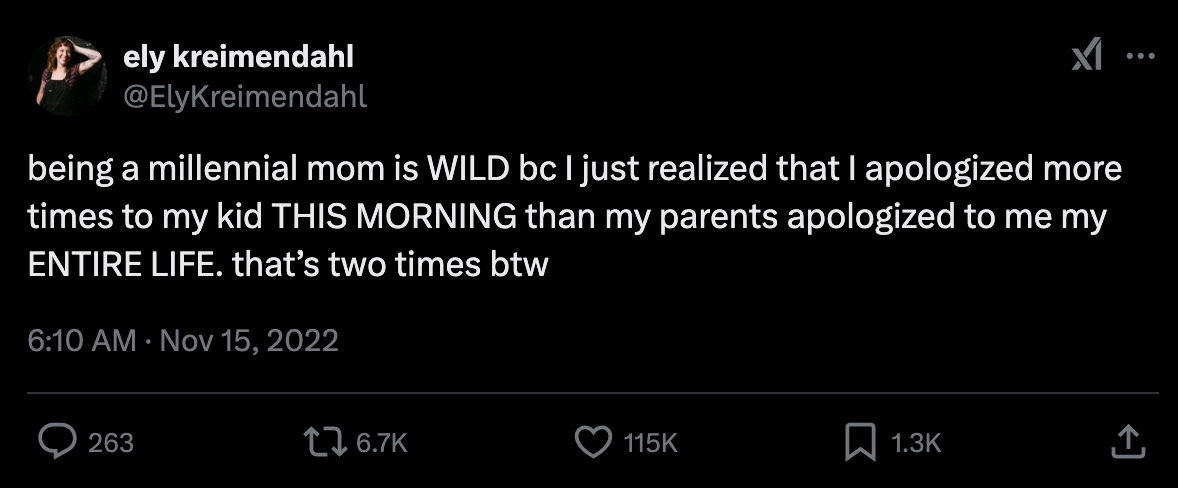
Welcome to my first Substack post since the 2024 U.S. presidential election — which, at the time, seemed like a good reason to skip a week: I had nothing productive to add to the discourse, and I could model prioritizing rest1 and recovery2 over robotic devotion to the writing factory.
But it wasn’t just a week or two off for extenuating circumstances - it was a few months off! Circumstances continued to extenuate in my a way that multiple professionals (therapist, psychic, and shaman) told me I needed to stop devoting mental energy to, so I won’t describe them here. And that was even before preschool let out for winter break and then stayed out due to unprecedented wildfires 🫠🫠🫠🫠🫠🫠
But, reader, I want you to know that was not okay. This Substack promises at least one newsletter a week. And it wasn’t right for me to just stop writing it without any explanation or recourse for you, so I’m sorry.
^^^see what I did there? That is what we in the gentle parenting game call repair, or at least the beginning of it. Let me tell you a little more about the concept of repair and how you can apply it to your writing practice.
I learned about repair in my doula Rebecca Benenati’s Mommy and Me class. I was concerned - and feel free to laugh at this - at how a DIFFERENT swim instructor was talking to a DIFFERENT child during my infant son’s swim class. The child was sobbing. The child did not want to be in the water with the instructor. The instructor was saying, “Mommy wants you to swim - you’ll make Mommy sad if you don’t swim!”
I, of course, was prepared to deliver this swim instructor to Gentle Parenting Jail myself, and start looking for a new swim school.3 How could this child’s parent live with themself knowing that their child now bore the deep psychological wound of being told that their refusal to swim was MAKING their MOMMY SAD??!!?!! And how could I prevent such a thing from ever happening to my precious, securely attached, self-determined child????
Rebecca was not concerned. “You can always repair,” she said. She told me it might look like saying, on the way home from this traumatic swim class, “You know how [teacher] said I was sad that you weren’t swimming? I want you to know I wasn’t sad. You will never make me sad by crying, or by not swimming. I’m sorry he said that, that wasn’t right.”4
This absolutely blew my mind, and also, makes so much sense!!! Small children are constantly making sense of what happens to them and those around them, crafting their understanding of how the world works. As their attachment figure, you can intervene in that sense-making and understanding-crafting to make sure they don’t have the wrong end of the stick.
I think this is an overlooked aspect of gentle/respectful/intentional/ conscious parenting, or whatever tf we’re calling it. There’s a perception that proponents of this style hold parents to an unreasonably high, stress-inducing standard, at which you can never lose your cool or let a child’s need go unmet or you’re dooming them to a lifetime of low self-esteem and poor mental health - when in fact, that perfectionism is relieved by this concept of repair.
For example…
You lose your temper.
Story your child might form: “My parent isn’t safe to be around — they could start yelling at me at any time.”
One way to repair: “I wanted to talk about how I yelled before. That wasn’t right. In our family we only yell if there’s danger, and I’m sorry I did that. I’m going to work to make sure I don’t do it again.”
Story you craft with repair: “I am safe with my parent.”
Your child is disruptively whining for [whatever - candy, TV, new toy] and you give it to them, despite having previously set a boundary.
Story your child might form: “I can get what I want by disruptively whining. My parent cares more about getting me to stop whining than about holding the boundary they previously set. Why DID they set that boundary, anyway? If I can get them to change their mind by screaming, is that boundary even that important?”
One way to repair: “I wanted to talk about how I let you [watch TV], even though our rule is [no TV during the week]. It was hard for me to see you so upset, so I let you do that, but that wasn’t right. We decided that [no TV during the week] was the best thing for our family because [remind/explain values behind boundary], and it’s my job to make sure we stick to that. So in the future, it’s okay to be upset about it, but I won’t be changing my mind.”
Story you craft with repair: My parent is devoted to [whatever the value behind the boundary is], no matter how much disruption I cause.
(At this point, you might be thinking, gosh, these “ways to repair” are like, kind of embarrassing and cringey???? Please feel free to find a cooler way to do it, or maybe this is a useful reminder that connection and clarity sometimes need to take precedence over feeling cool.)
Anyway:
You’ve given your child access to something that you want to walk back (screen, social media, substance, less supervision)
Story your child might form: I can’t trust my parent to keep me safe. My parent doesn’t care that I’m exposed to this risk.
One way to repair: “Hey, I know we previously agreed you could [watch R-rated movies/have a social media account/have your own computer/go to parties without adults present]. We’ve thought about it and actually we’re not comfortable with it. I know it might be disappointing, but it’s our job to keep you safe and healthy and we don’t think this is safe and healthy. I’m sorry we dropped the ball before. From now on we’re going to be paying more attention.”5
Story you craft with repair: “My parents are smart and informed, and can be trusted to give me responsibility when I’m ready for it. They prioritize my health and safety, even if I make it miserable for them to do so. Hmmmm, my health and safety must be pretty important…”
And by incorporating repair into your parenting, other stories are constantly getting crafted:
I don’t have to be perfect
I can change my mind when I get new information
I don’t have to be stuck in a situation that doesn’t work for me
It’s okay to have mistakes, miscommunications, and slip-ups in my relationships
I am not defined by the things I did in the past
These beliefs that underly the concept of repair are essential to a healthy creative practice.
I don’t have to be perfect - No creative process or product will ever be, and worrying about that is an immense waste of energy.
I can change my mind when I get new information / I don’t have to be stuck in a situation that doesn’t work for me - For example, maybe you have committed to a daily 1pm writing session, but when you implement it, you realize that you’re always tired around that time of day. Congratulations, you have some new information! Adjust accordingly. Or maybe you realize you are not as interested in a certain project - or even a form of creativity - as you once thought you were. This is fantastic information. BRAVELY PIVOT!
It’s okay to have mistakes, miscommunications, and slip-ups in my relationships / I am not defined by the things I did in the past - If your practice or projects have not manifested to your satisfaction, you don’t need to get married to that as the status quo. “I’m not good at writing [comedy/drama/for myself/about myself/pick your poison].” “I’m terrible with deadlines/I can never get my writing done/I can’t focus on my writing.” Whatever your attention or neglect to your creative practice has been so far, you can always start anew. Start anew many times, every day if you want! If you feel like you have not been attentive enough to your creativity, maybe you could start by writing it a letter apologizing and making some promises about how you’re going to treat it differently. I suggest making it extra cringey :)
watching approximately 50 episodes of Monk in bed
cooking the meatiest, cheesiest, most artery-clogging recipes known to man (like this one)
On the whole I do think it’s worthwhile to spend energy making sure your young children are in environments and around other adults that share your values, simply because then you have to spend less energy correcting/reinforcing your values. But that’s not the point of this anecdote, hence FOOTNOTE
She was also probably thinking, as I am now, that an extremely dysregulated child should not be forced to swim, but that wasn’t the issue at hand :)
Pretty sure this would have earned my parents a multi-week temper tantrum/icing out from 16-year-old Julia, but 37-year-old Julia would have had a lot more trust in and respect for them - for setting the boundary and for withstanding the tantrum and icing out.